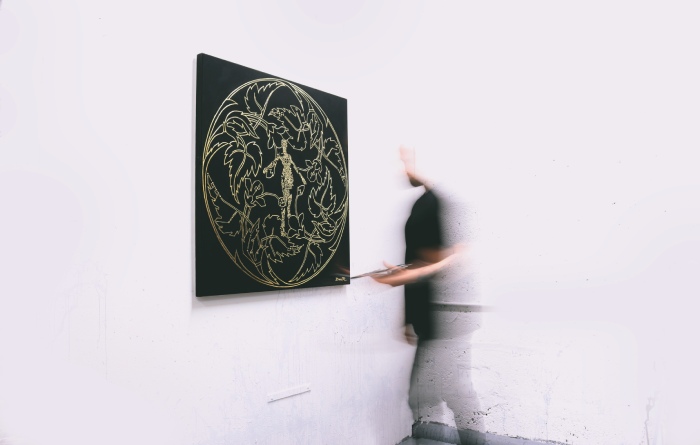
Search for gold paintings online and you'll encounter an enormous range of artworks.
Some use gold as a colour within the composition. Others incorporate metallic paint, imitation leaf, or genuine gold leaf.
All may be described as gold paintings, but they are not necessarily the same thing.
How is gold used in a painting
At its simplest, a gold painting is an artwork in which gold plays a significant role.
The more interesting question is how that role is being used.
In some works, gold functions primarily as an aesthetic choice. It introduces warmth, contrast, or visual impact within a room. The gold contributes to the appearance of the painting, but it is not central to its meaning.
In others, gold operates as both material and idea.
The artist chooses gold because of what it represents as well as how it looks. Gold carries a long cultural history. Across centuries it has been associated with value, permanence, illumination, and transcendence.
When used intentionally, those associations become part of the artwork itself.
This distinction explains why two paintings can share a similar colour palette while creating entirely different experiences. One may be decorative. The other may be asking questions about history, identity, memory, spirituality, or human value.
Gold in contemporary art
In David Roman's work, gold is never used simply to create a luxurious surface. Genuine gold leaf carries part of the meaning: its long association with the sacred, and the themes of inner transformation he explores through myth and symbolism. The original of The Alchemist is gilded in 24ct gold leaf over hand-built relief.