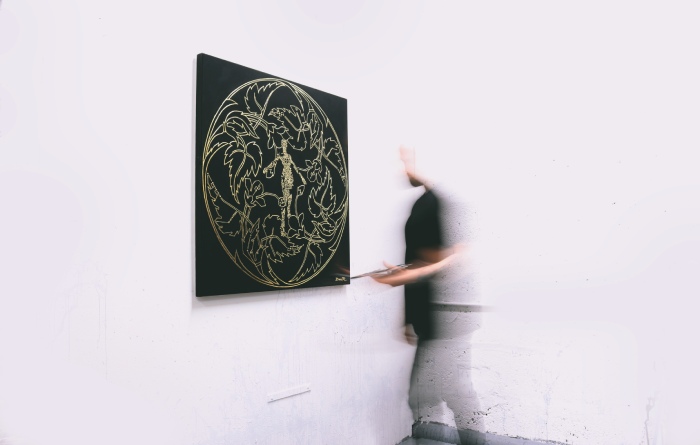
Gold has carried consistent symbolic associations across cultures that had no contact with each other, from ancient Egypt, Byzantium, pre-Columbian Mesoamerica, medieval Europe, and Japan.
All these cultures used gold in art to mean something beyond just its material beauty.
Understanding what those meanings are explains why contemporary artists who use gold today are important reflections of our culture.
Light and the divine
The most widespread use of gold in sacred art is as a representation of divine or transcendent light.
In Byzantine icon painting, the gold represents the uncreated light within which the holy figures exist.
This element is not decorative, it is a statement about the nature of the reality that underpins the Christian mystical tradition.
Used in sacred contexts, gold also acts as a mediator between the human and the divine realm, or an anchor that reconnects us to our innate divinity.
This transcendent role of the gold can be seen in medieval European altarpieces, in gilded temple architecture across South and East Asia, and in the solar symbolism of pre-Columbian gold artefacts.
The specific theology varies, but the association of gold with a luminous, transcendent reality recurs with extraordinary consistency.
Value and permanence
Pure gold does not tarnish or corrode. Left undisturbed, it looks the same in a thousand years as it does today.
This material property along with the rarity of the metal, led to its symbolic associations: value and permanence.
Funerary gold in ancient cultures expressed the idea of something preserved beyond death.
Gold in sacred architecture expressed the permanence of the divine against the transience of the human life.
Gold in contemporary art
Contemporary gold paintings rarely carry exactly the same meanings as historical religious works.
Instead, some artists use gold to explore questions of identity, memory, value, consumer culture, power, beauty, and human experience. The material remains relevant because it still carries the weight of its history.
In David Roman’s art, gold functions as a symbol of our innate divinity and our capacity for inner transformation. He draws on the icon tradition described above, and sets the gold against deep black in the original The Alchemist, laid in 24ct gold leaf over hand-built relief and dozens of layers of traditional gesso.