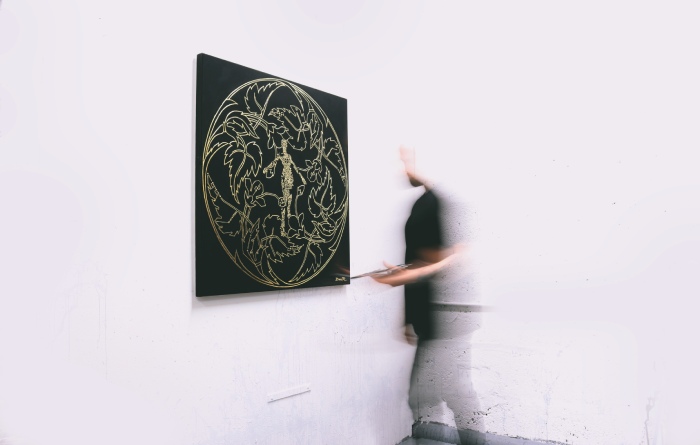
You do not need to understand contemporary art immediately. In fact, the need to explain a work too quickly gets in the way of experiencing it.
Three levels of understanding contemporary art
- The first is visual. You notice the materials, scale, colour, surface, imagery and physical presence of the work.
- The second is conceptual. You learn what the artist is exploring, what the piece belongs to and what ideas sit behind it.
- The third is biographical. You understand the life events, experiences or questions that shaped the artist’s perspective.
Then the circle widens again. The work connects to references, traditions, histories, symbols, political events, spiritual ideas, cultural pressures or other artists. A single artwork becomes part of a much larger web.
But not everything important in art is understood through explanation. Some things are felt before they are named. A piece might remind you of something without showing you exactly what. It might create a bodily response before you have a clear thought about it. That response is not less valid than facts. It is another form of connecting to the artwork.
For collectors, the question is not only “Do I understand it?”, but “Do I feel something in front of it?”
Curiosity, tension, attraction, discomfort or a desire to keep looking are all signs that the work has triggered something in you.
Explanation brings more context to that reaction, but it should not replace it. An artwork that only works as mental information doesn't stick with you in the same way as one that your body reacted to.