Gold Art Insight
What famous artists used gold leaf in their paintings?
From Byzantine icons to Gustav Klimt: why artists keep returning to gold
Gold leaf has appeared in art for more than a thousand years, but what is more interesting is how differently artists have used it in their work across time.
Some used gold to represent the divine. Others used it to challenge conventional ideas of painting. Some were drawn to its symbolic power, while others were fascinated by its ability to transform light itself.
Despite these differences, gold leaf has remained one of the few artistic materials that consistently carries both visual and cultural weight.
Gold in the Byzantine era
One of the most influential traditions emerged in Byzantine icon painting. Gold backgrounds were not intended to depict the immediate physical world. Instead, they created a symbolic space that existed outside ordinary time and place.
The presence of gold surface invited a transcendental experience.
These techniques would shape religious art across Europe for centuries and continue to influence artists today.
Gold in the Renaissance period
During the medieval and early Renaissance periods, gold remained an important artistic material. Painters such as Duccio and Giotto used gilded backgrounds and decorative details to communicate messages within religious layers.
As European painting gradually moved toward naturalism and perspective, extensive use of gold became less common, but it never disappeared entirely.
Gold in the Art Nouveau movement
Perhaps the most famous modern artist associated with gold leaf is Gustav Klimt.
His celebrated "Golden Phase" produced works such as The Kiss, where gold became far more than a decorative surface.
.jpg)
Influenced by Byzantine mosaics he encountered in Ravenna, Klimt combined precious materials with highly personal symbolism, creating paintings that felt simultaneously ancient and radically modern.
More than a century later, these works remain among the most recognisable uses of gold in art history.
Gold leaf use across cultures
Gold has also played an important role beyond European traditions. Japanese folding screens, Buddhist artworks, and decorative painting frequently incorporated gold leaf to create luminous surfaces that responded to changing light within architectural spaces.
In these contexts, gold was used to alter the atmosphere of a room, and inspire a sense of beauty and refinement.
Gold in contemporary practices
Contemporary artists continue to work with gold leaf for many of the same reasons their predecessors did.
While the cultural context has changed, the material still possesses a rare ability to communicate significance.
In a world saturated with digital images, gold invites presence and physical delight.
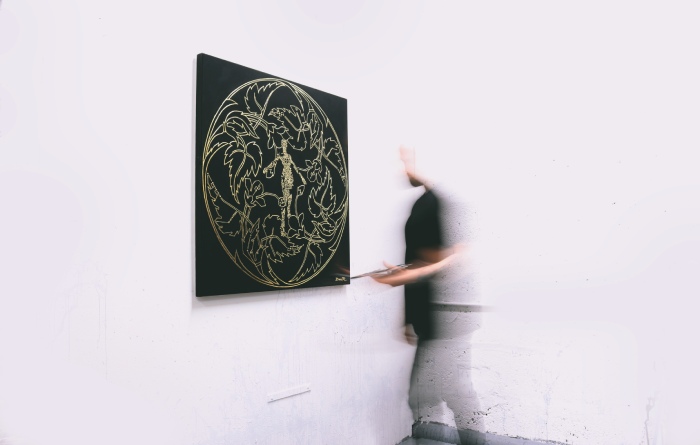
In David Roman’s work, the material’s long association with the sacred runs through the icon tradition he draws on. Rather than looking backward nostalgically, he uses genuine gold leaf to explore inner transformation through myth and symbolism, as in the original of The Alchemist, gilded in 24ct gold leaf.
Explore more gold art
From smaller format pieces to large-scale paintings, the artwork in the collection is made to reflect the contemporary times. Each piece is signed, documented, and available for collectors in UK and world-wide.

Discover your art buying archetype
Take a 3 minute quiz and find out what kind of art collector you are.